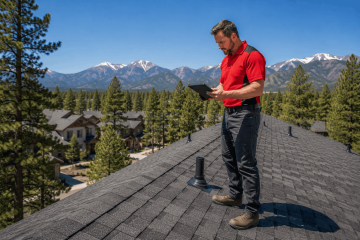
April in Munds Park. A homeowner pulls into the driveway for the first time since October, unlocks the front door, and walks into water-stained ceilings across multiple rooms. Drywall sagging. The unmistakable smell of mold.
Whatever the roof problem was, it started in November or December and ran unchecked for five months. The repair scope that would have been four hundred dollars in October is now somewhere north of fifteen thousand.
Snowbirds face a roof problem that year-round residents don’t. Small issues compound during long absences because nobody is there to notice them. A drip that an occupied homeowner catches in twelve hours runs uncaught for twelve weeks in an empty house, and by spring the math is brutal.
Heading out of town for the season? Get the roof checked before you leave. Call Polaris Roofing Systems at (928) 699-4840 or book a residential roofing inspection. Free, documented with photos, and we can flag and address anything that needs attention before your departure.
What to Do Before You Pack the Car
Schedule a professional pre-departure roof inspection three to four weeks before you leave. Have any flagged repairs done before departure.
Clear gutters, valleys, and drainage paths. Photograph every slope and every interior ceiling for your baseline records. Arrange property checks during your absence.
The whole prep takes one to two weeks of calendar time but saves you the spring nightmare.
Why an Empty House Is Where the Bad Surprises Hide
A leak in an occupied home reveals itself within hours. The owner notices a stain, a drip, the smell of damp. Repair scope stays small because the leak gets caught early.
An empty house has no early warning system. By the time anyone notices, the deck has rotted, the insulation has compacted, mold is established, and what would have been a four-hundred-dollar repair is now a five-figure remediation.
The other dynamic working against snowbird homeowners is that the worst weather happens during the absent months. Flagstaff winters bring snow loads, ice dams, freeze-thaw cycling, and the occasional powerful wind event. An empty house combined with bad weather is the highest-risk configuration for a roof, and it lasts five to six months for typical snowbirds.
What Makes Flagstaff Especially Risky for Absent Owners
Heavy snow loads. Flagstaff averages 90 to 100 inches of seasonal snowfall. A marginally engineered roof can collapse a section under heavy wet snow. We had one in 2019 where a Pinewood-area cabin had a partial truss failure during a March snow. Owner was in Phoenix. Discovered it a month later.
Wildlife seeking shelter. Squirrels, ravens, and packrats look for warm sheltered spots when temperatures drop. An empty attic is appealing real estate. We’ve found everything from chewed wiring to packrat nests in absent-owner attics. Our note on pest damage to roofs covers prevention.
The Phoenix-Flagstaff snowbird inversion. Many absent-owner customers leave Flagstaff for the winter and come back for summer. The empty months coincide with the worst weather of the entire calendar. By contrast, snowbirds in New England are empty during the milder months. The configuration here is uniquely demanding.
The Pre-Departure Routine
Get the Roof Walked Three to Four Weeks Out
Single most valuable thing you can do. Gives time to address whatever turns up before you’re on the road. Try to compress it into the last week and you usually run into contractor scheduling that pushes repairs past your departure date. Our overview of what an inspection covers walks through it.
Clear Drainage Paths
Pine needles in valleys and gutters become ice dams in winter. Water that can’t drain backs up, freezes, and finds its way under shingles. Have the cleaning done in late October or early November.
Address Flagged Repairs Now, Not Later
A four hundred dollar vent boot fixed in October is four thousand in interior remediation by April if it cracked further and dripped all winter. The marginal cost of doing the small repair before departure is the cheapest insurance available.
Photograph Everything
Walk the perimeter with your phone. Photograph every slope, every penetration, and the interior ceilings of every room. Email yourself the album so it’s accessible from anywhere. If something goes wrong, those photos prove the condition you left in. Our notes on roof insurance claim documentation cover what to capture.
Set Up Eyes While You’re Gone
Property check service, a trusted neighbor, smart cameras, or leak detection sensors in the attic and at vulnerable interior points. Choose what fits your situation. Just don’t leave the house entirely unwatched for five months.
Patterns From Years of Snowbird Inspections
Cracked vent boots the homeowner didn’t know existed. UV exposure all summer, then five months of freeze-thaw on a small crack, equals leak by April.
Late-season pine needle buildup that wasn’t there when the homeowner did their own check in August. Needle drop continues through October.
Lifted flashing at corners that looked fine in still conditions but lifted further during summer monsoon wind cycles.
Wildlife entry points around eaves or gable vents.
Attic ventilation issues that show up worse in winter. Why ventilation matters for Arizona homes covers the system view.
A Real Example From Last Winter
Owners of a Country Club Estates home left in mid-October. We did their pre-departure inspection two weeks before. Found two cracked vent boots and a section of lifted step flashing at the chimney. Replaced them all for $920 total. They came back in April. Roof was dry.
A different homeowner two blocks away, same neighborhood, never had a pre-departure check. Came back in April to discover a vent boot had failed sometime over winter. Total recovery bill: $16,400. The inspection that would have caught it was free.
Questions From Snowbirds We Hear Every Fall
When should I schedule the pre-departure inspection? Three to four weeks before you leave.
Do I need both pre-departure and spring inspections? Recommended yes, especially for higher-value homes or homes with prior leak history.
What about the rest of the house? We focus on roofs. For HVAC, plumbing, and general property condition you want a property management service.
Are gutter screens worth it for absent homeowners? Often yes. Our take on gutter screens walks through the cost-benefit.
Locally Owned, Looking Out for Absent Owners Since the Nineties
Polaris Roofing Systems has been the pre-departure inspector for snowbird and vacation cabin owners across Northern Arizona for over twenty five years. We coordinate cleanly with property managers, accept access through lockboxes when owners are out of town, communicate by email and text, and document everything thoroughly enough that a remote owner can read a report and understand what’s going on.
Book Your Pre-Departure Check
If you’re leaving Flagstaff for the season, give us a call before you start packing.
Call (928) 699-4840. Serving Flagstaff, Munds Park, Mormon Lake, Forest Highlands, Pinewood, Doney Park, Sedona, Prescott, Cottonwood, Williams, and surrounding Northern Arizona.